June 27th, 2010
Advisory says mainstream news media missed major point of the Rolling Stone profile by Michael Hasting, that is, the damning portrait of the U.S. war in Afghanistan. And, according to the Advisory, Hastings concluded that the media have mostly “given McChrystal a pass” on several controversies and scandals in the recent past.
Entire article follows.
Read the rest of this entry »
Tags: FAIR, General, General David Petraeus, General Stanley McChrystal, mainstream news media
Posted in Journalism, News/Commentary/Opinion | Comments Closed
June 26th, 2010
If this writer had been thinking clearly, he would have known that there would have to be a Part 2. And maybe even a 3. Braggadocio definitely on center stage but there is more. Tomorrow, Sunday, CNN’s Reliable Sources, will feature some pundits talking about the McChrystal affair. I can’ wait to see it.
However, I still like what I wrote in Part 1, that the General’s mooning of the Obama administration was contempt expressed in act of desperation. Regardless of what others have, might or will say. And I especially like this excerpt from Frank Rich of the New York Times:
There were few laughs in the 36 hours of tumult, but Jon Stewart captured them with a montage of cable-news talking heads expressing repeated shock that an interloper from a rock ’n’ roll magazine could gain access to the war command and induce it to speak with self-immolating candor. Politico theorized that Hastings had pulled off his impertinent coup because he was a freelance journalist rather than a beat reporter, and so could risk “burning bridges by publishing many of McChrystal’s remarks.”
That sentence was edited out of the article — in a routine updating, said Politico — after the blogger Andrew Sullivan highlighted it as a devastating indictment of a Washington media elite too cozy with and protective of its sources to report the unvarnished news.
Love it.
Full Rich Op Ed – The 36 Hours That Shook Washington – here.
Tags: Frank Rich, General Stanley McChrystal, President Obama, Rolling Stone Magazine
Posted in Journalism, News/Commentary/Opinion | Comments Closed
June 25th, 2010
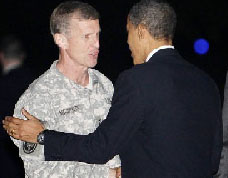 General Stanley McChrystal, Commander of the International Security Assistance Force (ISAF) and Commander of U.S. Forces Afghanistan (USFOR-A), described in several news accounts as being a fearless if not hedonis snake eater, did not cut-off-his-nose-to-spite-his-face. Rather, what he did (and I believe I understand why the pundits offering sycophantic explanations about his aggressive posturing missed this occurring faux pas) was moon the administration and he did it because …
Read the rest of this entry »
Tags: Afghanistan war, General Stanley McChrystal, ISAF, Paskistan, President Barack Obama, U.S. Military, USFOR-A
Posted in Journalism, News/Commentary/Opinion | Comments Closed
June 13th, 2010
By Andrew Kaplan
Nicholas Lemann, Dean of the Columbia University School of Journalism, Delivers 2010 Commencement Speech on Future of Media, Excerpt:
The media reform movement, as always, is mainly focused on limiting the power of big media companies and on improving public access. Therefore, its main causes regarding the Internet are universal broadband access, so that everybody everywhere can have fast service, and net neutrality, so that Internet service providers have to continue giving every user equal access to every Web site.
Internet service providers, as always, are pushing back against the media reform movement—and journalists are almost nowhere to be found in the debate. Read entire blog here.
Reboot.FCC.gov is the Federal Communication Commission’s website for discussion on how to transform the FCC into a model of excellence in government.
Tags: Columbia School of Journalism, future of journalism, Nicholas Lemann
Posted in Journalism, Journalism Education, News/Commentary/Opinion | Comments Closed
June 11th, 2010
By Writer Juan Arellano, Translated by Silvia Viñas
“The period of terrorism by the Sendero Luminoso (Shining Path) and the Tupac Amaru Revolutionary Movement (MRTA) ) in Peru is part of the country’s recent history; a period fairly but not yet sufficiently analyzed and much less researched and accepted. Those who lived it hope that something similar never happens again, and they reasonably fear the slightest chance of its reoccurrence. But what happens when our fear affects other people’s rights?”
Read the entire article here. GlobalVoices is a community of more than 300 bloggers and translators around the world who work together to bring you reports from blogs and citizen media everywhere, with emphasis on voices that are not ordinarily heard in international mainstream media.
Lori Berenson Freed! – the WORD
Tags: Lori Berenson, MRTA, Peruvian Terrorism, Rhoda and Mark Berenson, Shining Path
Posted in Journalism | Comments Closed
June 10th, 2010
By Marian Wang
Getting statistics on worker illness related to the Gulf oil spill is proving to be difficult, as federal agencies continually refer requests either to another federal agency or to BP.
Read the rest of this entry »
Tags: BP, Gulf oil spill, OSHA
Posted in Journalism, News/Commentary/Opinion | Comments Closed
June 10th, 2010
By Marian Wang and Sasha Chavki
Containment domes, top hats and top kills. By now BP and the government have tried to stop the growing environmental disaster in the Gulf of Mexico with a series of different techniques, each with an odder name than the next.
But where are all these ideas coming from, we’ve wondered. Did BP or the government have plan in place in the event of a blowout?
The answer, so far as we can see: No. None of the documents and plans we’ve been able to find have details on how to deal with a blowout.
Read entire blog here.
Tags: containment domes, Gulf Oil Crisis, PB, U.S. Coast Guard
Posted in Journalism, News/Commentary/Opinion | Comments Closed
June 9th, 2010
By Robert Scheer, Truthdig.com
The media tirade against Helen Thomas is as illogical as it is hysterical. The few sentences uttered by her were, as she quickly acknowledged, wrong—deeply so, I would add. But they cannot justify the road-rage destruction of the dean of the Washington press corps. Suddenly this heroic woman who broke so many gender barriers and dared to challenge presidential arrogance was reduced to nothing more than the stereotypical anti-Israel Arab that it is so fashionable to hate.
Read entire column here.
Tags: helen thomas, Israeli- Palestinian crisis, Robert Scheer, truthdig, White House Press Corps
Posted in Journalism, News/Commentary/Opinion | Comments Closed
June 8th, 2010
By Michael Fauntroy
Professor, Author, Columnist
and Commentator at MichaelFauntroy.com
“Helen Thomas recently set off a firestorm with her comment that Jews should “get the hell out of Palestine” and “go home” to Germany or Poland. The comments resulted first, and predictably, with her apology. Over the weekend, with the heat turned up considerably, she decided to retire immediately (before she was fired).”
If Helen can be forced out, writes M. Fauntroy, why not the nativistic Pat Buchanan?
Read entire blog here.
Other articles:
New York Times
Politico
Notes From a Grumpy Old Man
Tags: associated press, helen thomas, nativism in journalism, nativists, pat buchanan, racism in journalism
Posted in Journalism, News/Commentary/Opinion | Comments Closed
June 7th, 2010

By Marian Wang
Estimating oil flow from BP’s ruptured well in the Gulf of Mexico has consistently been a subject of contention among the oil company, the government and the skeptics who believe that official estimates significantly low-ball the scale of the disaster.
Read the rest of this entry »
Tags: BP Oil Crisis, Gulf of Mexico, oil spills
Posted in Journalism | Comments Closed
FAIR Media Advisory: News Media Missing the McChrystal Point
June 27th, 2010Advisory says mainstream news media missed major point of the Rolling Stone profile by Michael Hasting, that is, the damning portrait of the U.S. war in Afghanistan. And, according to the Advisory, Hastings concluded that the media have mostly “given McChrystal a pass” on several controversies and scandals in the recent past.
Entire article follows.
Read the rest of this entry »
Tags: FAIR, General, General David Petraeus, General Stanley McChrystal, mainstream news media
Posted in Journalism, News/Commentary/Opinion | Comments Closed